Validation
This page explains the VQkit pre-flight calculation checker in detail.
The pre-flight checker is designed to identify common input problems before a VASP or Quantum ESPRESSO calculation is submitted.
It is available from:
[1] Pre-processing
[6] Pre-flight calculation check
The checker does not run the DFT calculation.
It examines the available input files and reports:
required files that are missing;
malformed or inconsistent input settings;
warnings that deserve manual review;
useful calculation metadata;
whether the setup is ready for submission.
The final status is reported as:
[READY]
[READY WITH WARNINGS]
[NOT READY]
Meaning of report levels
VQkit classifies each check using one of four levels.
OK
[OK]
The item passed the implemented consistency check.
Example:
[OK] ENCUT - 520 eV
WARNING
[WARNING]
The calculation may still run, but the setting should be reviewed.
Examples include:
ENCUT not explicitly defined;
MAGMOM missing for a spin-polarized VASP calculation;
QE
ecutrhonot explicitly defined;non-flat or uncertain settings;
an unusual band-path specification.
A warning does not automatically mean the calculation is wrong.
ERROR
[ERROR]
A blocking problem was found.
Examples include:
missing required input file;
invalid atom count;
missing pseudopotential;
inconsistent POSCAR/POTCAR species order;
invalid QE cell;
missing
K_POINTS.
A report containing at least one ERROR is classified:
[NOT READY]
INFO
[INFO]
Informational items do not block submission.
Examples include:
an optional job script is present or absent;
selective-dynamics constraints are detected;
QE
outdirlocation;repeated INCAR tags with the same value.
Code detection
VQkit first determines whether the working directory appears to contain:
VASP inputs;
Quantum ESPRESSO inputs;
both;
neither.
If only one code is clearly detected, VQkit uses it automatically.
If both VASP and QE files are detected, VQkit asks which code should be validated.
If neither can be determined, VQkit also asks the user to select the code.
VASP pre-flight validation
For VASP, VQkit checks the following required files:
INCAR
POSCAR
KPOINTS
POTCAR
Each file is checked for:
existence;
non-zero file size.
If any required file is missing or empty, VQkit reports an ERROR.
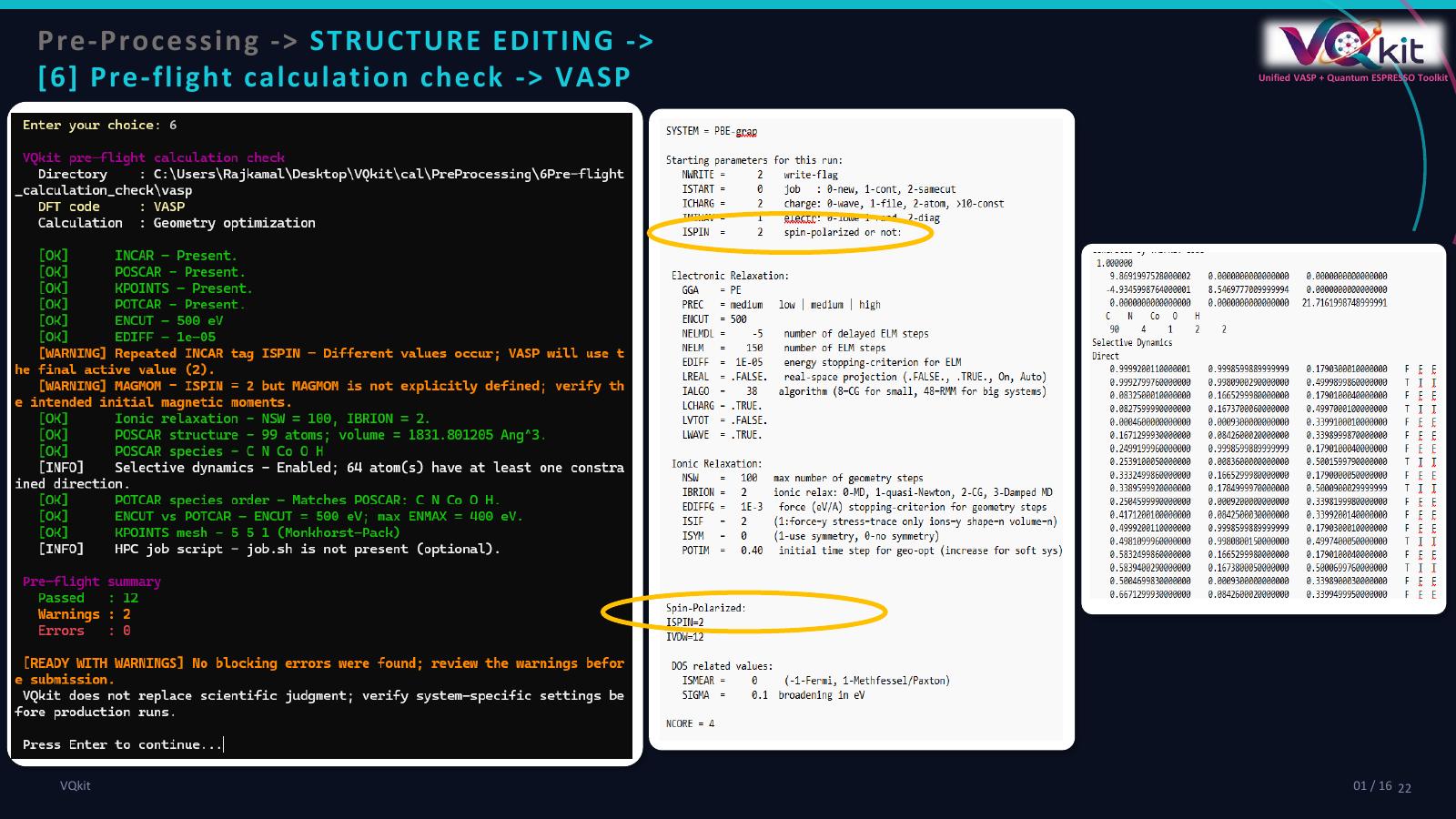
INCAR checks
VQkit parses active KEY = VALUE INCAR lines while ignoring normal !
and # comments.
ENCUT
If ENCUT is missing:
[WARNING] ENCUT - ENCUT is not explicitly set.
If it is present but invalid or non-positive:
[ERROR] ENCUT - ENCUT must be a positive numeric value.
If valid:
[OK] ENCUT - 520 eV
EDIFF
VQkit performs a similar check for:
EDIFF
If it is absent, a warning is issued because the electronic convergence threshold is not explicitly controlled.
Spin setup
VQkit checks ISPIN.
If:
ISPIN = 2
but MAGMOM is absent, VQkit reports:
[WARNING] MAGMOM
ISPIN = 2 but MAGMOM is not explicitly defined.
If both ISPIN = 2 and MAGMOM are present, the spin setup is reported
as OK.
If:
ISPIN = 1
VQkit reports that the calculation is non-spin-polarized.
This check does not determine whether the chosen magnetic configuration is scientifically correct.
Ionic-relaxation consistency
VQkit checks the relationship between:
NSW
IBRION
If NSW > 0 but IBRION is not explicitly defined, VQkit issues a
warning.
If:
NSW > 0
IBRION = -1
VQkit warns that ionic motion may not actually be configured as intended.
Otherwise, a normal relaxation setup is reported with the detected NSW
and IBRION values.
POSCAR checks
VQkit parses the POSCAR structure and checks:
total atom count;
lattice vectors;
cell volume;
element symbols where available;
selective-dynamics constraints.
Cell volume
The lattice volume must be finite and positive.
If the cell has zero or invalid volume:
[ERROR] POSCAR lattice
Otherwise, VQkit reports the number of atoms and the cell volume.
Example:
[OK] POSCAR structure - 24 atoms; volume = 312.456789 Ang^3
Species information
For a VASP 5-style POSCAR containing element symbols, VQkit records the species order.
Example:
Fe O
For an old VASP 4-style POSCAR without element symbols, VQkit cannot automatically verify the POTCAR species order and therefore reports a warning.
Selective dynamics
If selective dynamics is enabled, VQkit counts how many atoms have at least one constrained coordinate.
Example:
[INFO] Selective dynamics
       Enabled; 8 atom(s) have at least one constrained direction.
POTCAR checks
VQkit inspects POTCAR metadata including:
TITELentries;element/dataset order;
ENMAXvalues.
POSCAR versus POTCAR species order
For a VASP 5-style POSCAR, VQkit compares the expected element order with the POTCAR dataset order.
Example POSCAR:
Fe O
Correct POTCAR order:
Fe -> O
If the number of POTCAR datasets differs from the number of POSCAR species, VQkit reports an ERROR.
If the order differs, VQkit reports an ERROR such as:
POSCAR: Fe O
POTCAR: O Fe
This is a blocking input inconsistency.
POTCAR variants
When comparing labels such as:
Fe_pv
Ti_sv
VQkit compares the base element symbol to the POSCAR species.
Therefore:
Ti_sv
is recognized as belonging to element Ti for the purpose of species-order
validation.
ENCUT versus ENMAX
VQkit extracts all available POTCAR ENMAX values and calculates:
It then compares the INCAR cutoff:
with the maximum POTCAR recommendation.
If:
VQkit reports a warning.
Example:
ENCUT = 400 eV
max POTCAR ENMAX = 520 eV
may produce:
[WARNING] ENCUT vs POTCAR
ENCUT = 400 eV is below max POTCAR ENMAX = 520 eV.
If ENCUT is equal to or greater than the maximum ENMAX, the
consistency check passes.
This is only a minimum sanity check.
A proper production calculation should still use a converged plane-wave cutoff.
KPOINTS validation
VQkit reads the KPOINTS file and recognizes several common forms.
Automatic mesh
For Gamma or Monkhorst-Pack automatic meshes, VQkit checks that:
three mesh dimensions are present;
each mesh value is a positive integer.
Example:
6 6 1
is reported as valid if parsed correctly.
Line mode
If line-mode syntax is detected, VQkit reports:
Line-mode/high-symmetry path detected.
This is useful for band-structure calculations.
Explicit k points
Other valid non-automatic definitions are reported as:
Explicit/non-automatic k-point definition detected.
HPC job script
VQkit checks whether:
job.sh
exists.
Its presence or absence is informational only.
A missing job.sh does not make the VASP input invalid.
VASP example report
A typical report may look like:
VQkit pre-flight calculation check

Directory    : /path/to/calc
DFT code     : VASP
Calculation  : relax

[OK]      INCAR - Present.
[OK]      POSCAR - Present.
[OK]      KPOINTS - Present.
[OK]      POTCAR - Present.
[OK]      ENCUT - 520 eV
[OK]      EDIFF - 1e-06
[OK]      Spin setup - ISPIN = 2 and MAGMOM is present.
[OK]      POSCAR structure - 24 atoms; volume = ...
[OK]      POTCAR species order - Matches POSCAR: Fe O
[OK]      ENCUT vs POTCAR - ENCUT = 520 eV; max ENMAX = ...
[OK]      KPOINTS mesh - 6 6 1 (Gamma)

Pre-flight summary
Passed   : ...
Warnings : ...
Errors   : ...

[READY]
Quantum ESPRESSO pre-flight validation
For QE, VQkit searches for pw.x input files.
Recognized files are *.in files containing at least:
&CONTROL
&SYSTEM
If exactly one suitable input exists, VQkit selects it automatically.
If multiple QE inputs exist, VQkit displays a menu so the user can choose the file to validate.
Examples may include:
scf.in
relax.in
vc-relax.in
nscf.in
bands.in
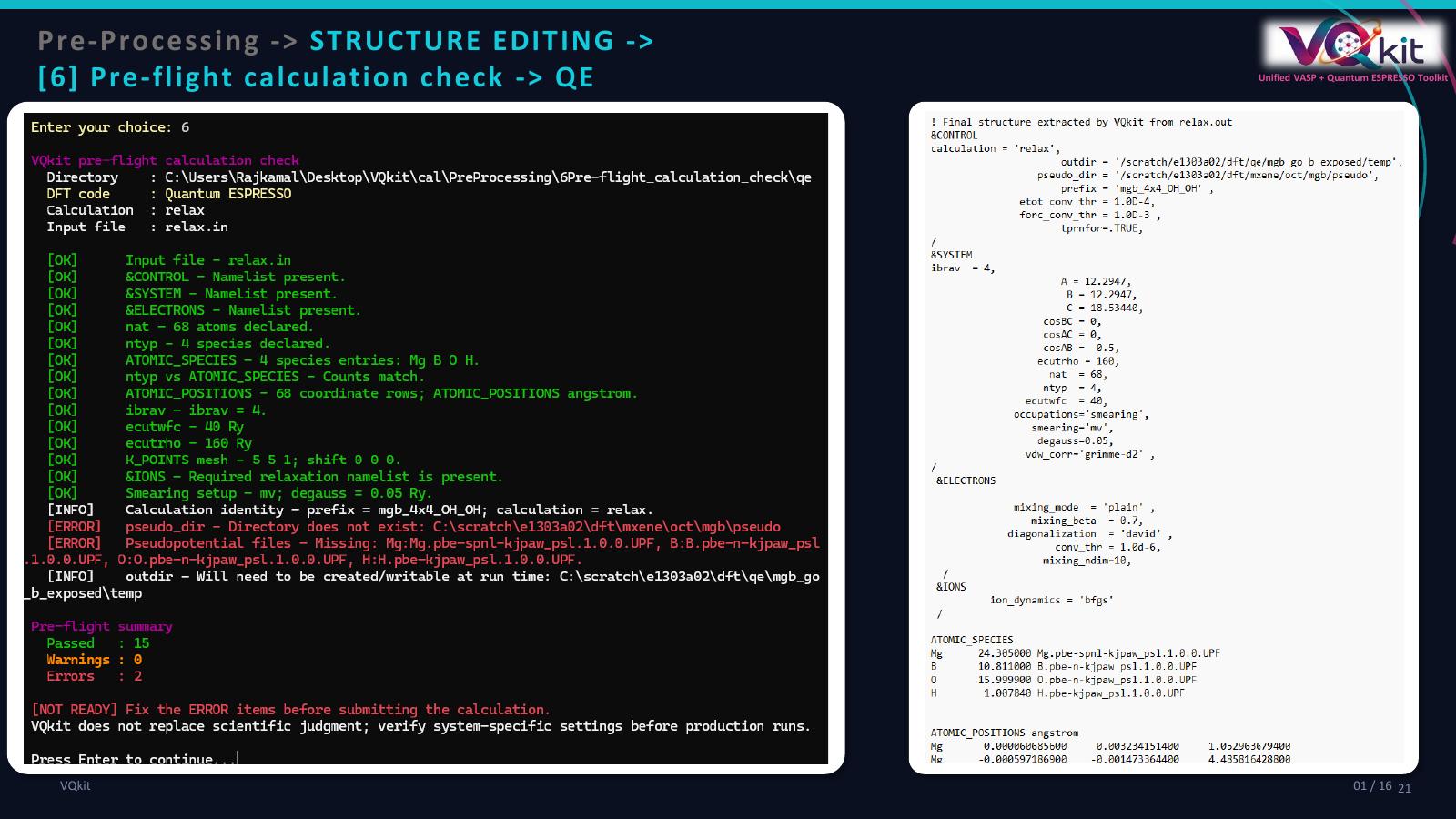
Required QE namelists
VQkit checks for:
&CONTROL
&SYSTEM
Both are required for the current pw.x validation workflow.
If either is missing, VQkit reports an ERROR.
ELECTRONS namelist
&ELECTRONS is checked separately.
If present:
[OK] &ELECTRONS
If absent, VQkit reports an informational message because QE defaults may be valid in some cases.
nat and ntyp
VQkit reads:
nat
ntyp
Both must be positive integers.
For example:
nat = 8
ntyp = 2
If either is missing or non-positive, an ERROR is reported.
ATOMIC_SPECIES
VQkit parses the:
ATOMIC_SPECIES
block.
It checks:
whether the block exists;
how many species entries are present;
whether that count matches
ntyp.
Example:
ntyp = 2

ATOMIC_SPECIES
  Fe  55.845  Fe.UPF
  O   15.999  O.UPF
passes the count consistency check.
If ntyp = 2 but three species entries are present, VQkit reports an ERROR.
ATOMIC_POSITIONS
VQkit checks that:
ATOMIC_POSITIONS
exists and contains numerical coordinate rows.
The number of coordinate rows is compared with nat.
If:
nat = 8
but only seven positions are found, VQkit reports an ERROR.
Lattice validation
VQkit reads:
ibrav
If:
ibrav = 0
the input must contain exactly three valid:
CELL_PARAMETERS
vectors.
VQkit calculates the cell volume and rejects a zero or invalid lattice.
If ibrav is not explicitly specified, VQkit reports a warning asking the
user to verify the lattice definition.
Plane-wave cutoffs
VQkit checks:
ecutwfc
ecutrho
For each value:
missing -> WARNING;
non-positive -> ERROR;
positive -> OK.
Example:
ecutwfc = 60
ecutrho = 480
may produce:
[OK] ecutwfc - 60 Ry
[OK] ecutrho - 480 Ry
VQkit does not determine whether these values are scientifically converged.
K_POINTS validation
The QE input must contain:
K_POINTS
If the card is missing, VQkit reports an ERROR.
Automatic mesh
For:
K_POINTS automatic
VQkit expects a following mesh/shift line with six integers:
nk1 nk2 nk3 sk1 sk2 sk3
The first three values must be at least 1.
The shift values must be:
0
1
Example:
K_POINTS automatic
6 6 1 0 0 0
is valid.
Band-structure path
If the QE calculation type is:
calculation = 'bands'
VQkit checks whether the K_POINTS card uses a band-path format such as:
crystal_b
tpiba_b
If not, a warning is issued asking the user to verify the high-symmetry path.
Relaxation-specific checks
For:
calculation = 'relax'
VQkit requires:
&IONS
If missing, an ERROR is reported.
For:
calculation = 'vc-relax'
VQkit requires both:
&IONS
&CELL
Missing either required namelist results in an ERROR.
Smearing consistency
If:
occupations = 'smearing'
VQkit checks whether:
smearing
degauss
are explicitly defined.
Missing smearing produces a warning.
Missing or non-positive degauss also produces a warning.
A complete setup such as:
occupations = 'smearing'
smearing = 'mv'
degauss = 0.02
is reported as valid.
Calculation identity
VQkit reports the detected:
prefix
calculation
as informational metadata.
For example:
prefix = graphene
calculation = scf
pseudo_dir validation
VQkit resolves:
pseudo_dir
relative to the QE input directory when necessary.
The directory must exist.
If it does not:
[ERROR] pseudo_dir
is reported.
Pseudopotential file validation
VQkit reads the UPF filename associated with every ATOMIC_SPECIES entry.
It then verifies that each referenced file exists in pseudo_dir or at the
specified absolute path.
Example:
ATOMIC_SPECIES
  C  12.011  C.UPF
  O  15.999  O.UPF
If C.UPF exists but O.UPF does not, VQkit reports an ERROR listing the
missing species/file pair.
Example:
[ERROR] Pseudopotential files
Missing: O:O.UPF
This is a blocking issue.
outdir
VQkit also resolves:
outdir
If the directory already exists, it is reported as informational.
If it does not yet exist, VQkit reports that it will need to be created and writable at run time.
A missing outdir directory is not automatically treated as a blocking
error because QE can create suitable directories during execution depending on
the environment.
QE example report
A typical report may look like:
VQkit pre-flight calculation check

Directory    : /path/to/qe
DFT code     : Quantum ESPRESSO
Calculation  : scf
Input file   : scf.in

[OK]      Input file - scf.in
[OK]      &CONTROL - Namelist present.
[OK]      &SYSTEM - Namelist present.
[OK]      &ELECTRONS - Namelist present.
[OK]      nat - 2 atoms declared.
[OK]      ntyp - 1 species declared.
[OK]      ATOMIC_SPECIES - 1 species entries: C.
[OK]      ntyp vs ATOMIC_SPECIES - Counts match.
[OK]      ATOMIC_POSITIONS - 2 coordinate rows.
[OK]      CELL_PARAMETERS - Three lattice vectors found.
[OK]      ecutwfc - 60 Ry
[OK]      ecutrho - 480 Ry
[OK]      K_POINTS mesh - 12 12 1; shift 0 0 0.
[OK]      pseudo_dir - /path/to/qe/pseudo
[OK]      Pseudopotential files - All referenced UPF files are present.

[READY]
READY logic
VQkit determines final readiness from the number of ERROR items.
READY
If there are:
0 errors
0 warnings
the report ends with:
[READY] No blocking errors or warnings were found.
READY WITH WARNINGS
If there are:
0 errors
1 or more warnings
the report ends with:
[READY WITH WARNINGS]
This means VQkit found no blocking syntax or consistency problem, but manual review is still required.
NOT READY
If there is at least one ERROR:
[NOT READY]
The ERROR items should be corrected before submitting the calculation.
What the checker does not validate
The pre-flight checker is intentionally conservative.
A READY result does not prove that the calculation is scientifically
correct.
VQkit does not automatically determine whether:
the chosen exchange-correlation functional is appropriate;
a Hubbard U value is justified;
a magnetic ordering is physically correct;
a k-point mesh is converged;
a plane-wave cutoff is converged;
a vacuum region is sufficiently thick;
a slab requires dipole correction;
an NEB pathway is physically meaningful;
a smearing width is optimal;
the structure represents the intended phase;
the chosen pseudopotential variant is the best one.
These remain scientific decisions.
Recommended workflow
Before submitting a VASP calculation:
Generate or prepare the input files.
Verify the structure.
Verify POTCAR species order.
Verify pseudopotential variants.
Check ENCUT.
Check KPOINTS.
Check spin settings.
Run the pre-flight check.
Resolve all ERROR items.
Review all WARNING items.
Submit the calculation.
Before submitting a QE calculation:
Verify
&CONTROLand&SYSTEM.Check
natandntyp.Verify
ATOMIC_SPECIES.Verify all UPF files.
Check
ATOMIC_POSITIONS.Check the lattice definition.
Review
ecutwfcandecutrho.Check K_POINTS.
Check relaxation-specific namelists where required.
Run the pre-flight check.
Resolve all ERROR items.
Review all WARNING items.
Scientific responsibility
The purpose of the pre-flight checker is to reduce avoidable setup mistakes.
It should be treated as a technical and consistency check, not as an automatic scientific approval system.
As emphasized in the original VQkit guide:
VQkit does not replace scientific judgment.
Users must still verify all system-specific settings before production calculations.